Video Games in Hospitals: the Siemens Case Study

Video games are no longer a small, self-contained world, nor a niche for enthusiasts only.
In the digital and technological era, they have become multi-context tools, used in different fields for different kinds of objectives.
From edutainment to training, and all the way to corporate gamification projects, web games are turning into tools for learning and for a new kind of social interaction.
Because they’re attractive, quick to enjoy and, above all, within everyone’s reach on a smartphone.
Today we’ll take a closer look at a very interesting case linked to a well-known German brand.
This story begins with a rather unusual email, but we’ll get to that in just a moment.
First, let’s recall who Siemens is and how its identity has evolved over the years.
The brand was founded in 1847 in Berlin by Werner von Siemens and Johann Georg Halske.
Initially, the company produced electrical measuring instruments, but it later established itself in the telecommunications and energy sectors.
After World War II, in the 1950s, Siemens expanded into communications. Over the years, the company kept growing, acquiring many other businesses and becoming a diversified corporation producing products for several industries, including energy, transportation, and IT.
Today, Siemens is one of the largest technology companies in the world, with over 300,000 employees.
It is also strongly focused on innovation, developing advanced technologies such as artificial intelligence and the Internet of Things (IoT), to improve productivity and business sustainability.
The German brand was therefore selected to supply hi-tech equipment within a number of hospitals in Germany, Switzerland, and Belgium.
The psychological dimension of hospitalized patients is very delicate ground: physical discomfort can create serious strain on mental and emotional wellbeing as well. For this reason, many hospitals work to improve the quality of life for bedridden patients, offering activities and tools for entertainment and/or educational outreach.
Siemens’ mission was to bring high-end devices into hospitals that could support patients’ stays, especially in those cases where they cannot move around.
So what did they choose to do?
Siemens: The Strategy
This brings us to the day of the unusual email, sent by one of Siemens’ managers in the Digital Division.
The email went more or less like this:
- We came across you at a technology fair in Berlin—not directly, but through people who spoke to us about you and the products you develop. We took a look at your catalogue and we’re interested in creating video games for devices that will be installed in hospitals. What do you think?
We’re happy to be able to tell this story from an internal point of view, since we ourselves received that email in 2019.
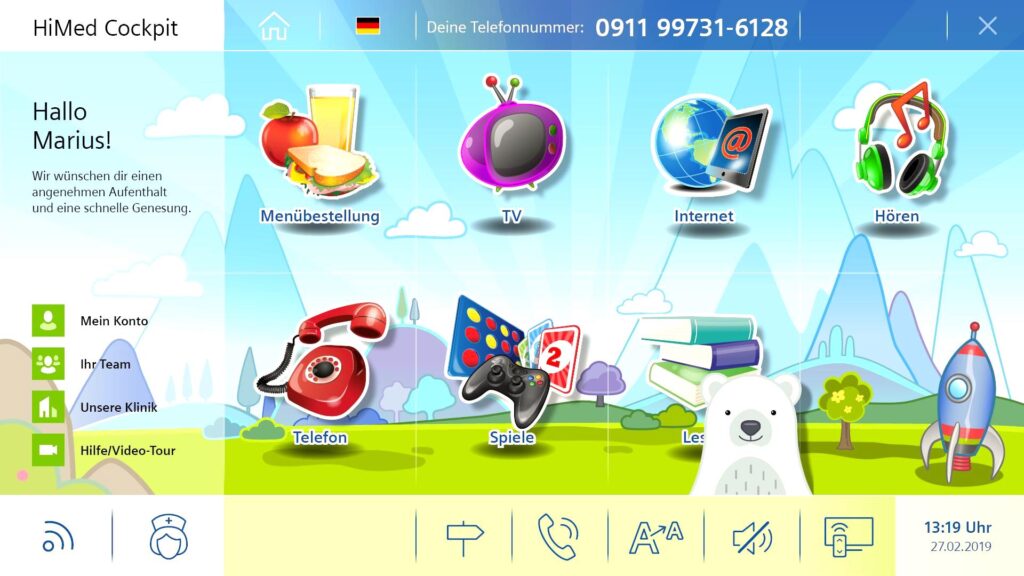
This is where Siemens’ strategy began: the company aimed to provide the HiMed solution, meaning the Cockpit Pro devices launched on the market in 2018, equipped with a wide range of useful content—maps, books, information, music and, above all, web games.
Some hospitals also offered a premium service that included a Sky subscription and video on demand.
Since the project spanned three countries, all resources were available in three languages—just like our video games.
The Video Games Selected by Siemens
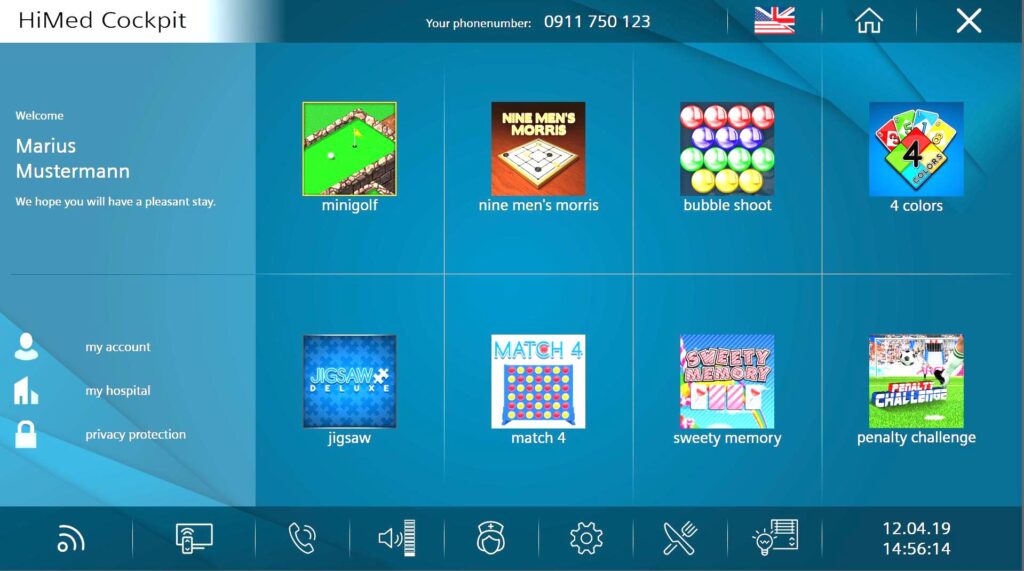
It was very interesting to work with Siemens: identifying the right games for the project, presenting them in three different languages, and sharing a new, highly educational, experience with the team.
In recent years, more and more hospitals have been providing patients with leisure tools, especially digital ones.
For example, patients in wards or outpatient settings commonly use tablets to access games and other activities.
But many hospitals also use gaming consoles such as PlayStation, Xbox, and Nintendo.
Staff often use these devices in paediatric wards or paediatric oncology units to help children “get through” hospital days and cope with a reduced social life.
However, the Siemens case involved fixed, high-performance devices. For this reason, we selected 10 web games suited to the project’s purpose and compatible with the devices provided by the brand.
The team presented each game in English, French, and German.
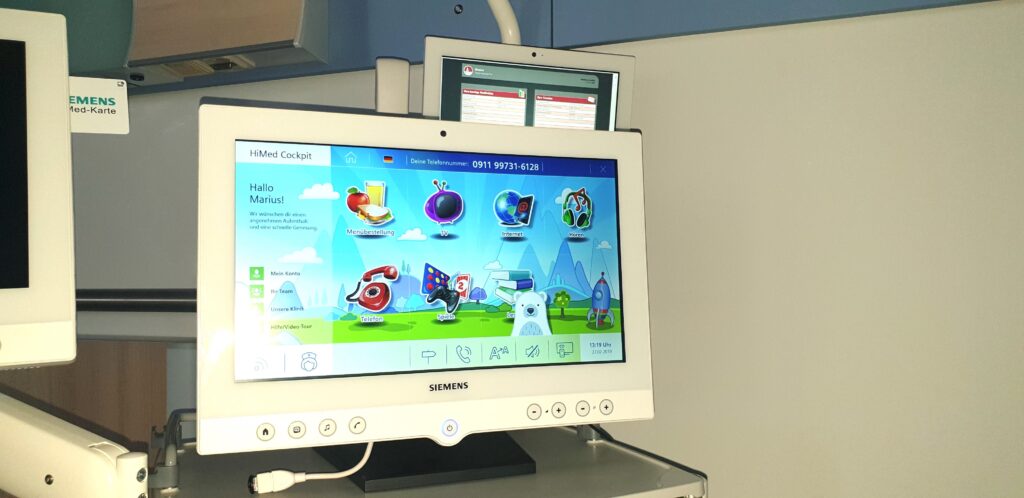
Here are the games: click the title to play!
- Four Colors
- Puzzle Jigsaw deluxe
- Sweety Memory
- Connect 4
- Mini Golf World
- Coloring Book
- Penalty Challenge
- Bubble Shooter
- Olaf the Viking
- Nine mens morrris
Would you like to learn more, or do you have a video game project in mind?
Sources: Siemens, Wikipedia, Code This Lab s.r.l.