Gamification: Examples, Tools, and Useful Strategies

The concept of gamification emerged in 2010, during a conference by Jesse Schell in Las Vegas, where the American game designer explored the topic. However, it is an activity that dates back to around 2002 and, in recent years, has become popular in many fields, from education and public outreach to business and marketing.
What is gamification?
Over the years, researchers and practitioners have proposed many definitions, and we can summarize them as follows:
Gamification is the “playful transformation” of a non-playful activity, applying game dynamics and game design to contexts of a different nature, such as institutional, corporate, or educational settings.
Note: this does not mean turning work or learning into a game. Instead, it means applying the logic of games to the activities we care about.
- Example: in the context of urban gamification, Volkswagen selected a European project (among many proposals) to raise drivers’ awareness about speed limits. In short, a sort of “smart speed camera” photographed cars passing through the city center and measured their speed: those who exceeded the limit received a standard fine, while those who stayed under the limit could enter a lottery. The cash prize was funded by the fines paid by speeding drivers.
In this case, drivers were engaged through a reward.
The idea of “rewarding” fits perfectly within game dynamics
- Example: in education, teachers use platforms that let them create quizzes and multiple-choice tests on school subjects, with accompanying leaderboards for the “players.”
Here, the final ranking encourages competition and the desire to stand out among participants.
These examples help us see, up close, how you can make a dynamic playful even when it isn’t (or doesn’t normally include game mechanisms such as goals and rewards). Ultimately, it’s about stimulating some primal aspects of our nature: challenge, competition, loot.
Therefore, gamification doesn’t only help teams (or even elementary school classes) achieve goals, it can also re-energize the individual by providing new stimuli.
In essence, it can be a winning formula against everyday “quiet enemies” like boredom, apathy, and lack of motivation at work.

Why is there often confusion around gamification?
Recently, the gaming world—especially in marketing—has been full of ideas and possibilities: video games, advergames, web games, and more.
All these products share a common denominator: the game.
However, each activity uses games in a different way.
While an advergame, for example, is a branded video game that communicates the identity of a product and/or a specific brand, gamification, as we’ve seen, is not a game in itself: it is the application of a game-like logic.
Also, gamification is not necessarily digital, even though that is the current trend; it can also include analog dynamics.
- Example: rewarding children with a star and “penalizing” them with a cloud is a typical family dynamic that encourages a child to “do well” and follow the rules of the household community; after a set number of stars or clouds, the agreed “gift” or “penalty” applies.
In this case, it’s simply a chart drawn on a colorful piece of cardboard, no digital or technological tool involved. Yet it’s still gamification.
Later, we’ll look at application areas and the tools needed for a successful project.
Gamification: Application areas and objectives
Gamification can be introduced easily into (almost) any context, while respecting the boundaries of the sector and shared rules. Of course, each specific area requires a different project depending on the objective, the target audience, and the tools available.
Let’s look at the main areas where gamification has been used most in recent years.
Corporate
Many companies adopt gamification projects for different reasons: from recruiting to training, and even employee assessment initiatives.
Imagine, for instance, a digital “game” made of goals and tests that reflect an insurance agent’s mission and monthly work. It’s certainly not a game in the traditional sense.
Institutional
For large-scale awareness campaigns, some institutions choose gamification to engage the public and guide them toward the campaign message.
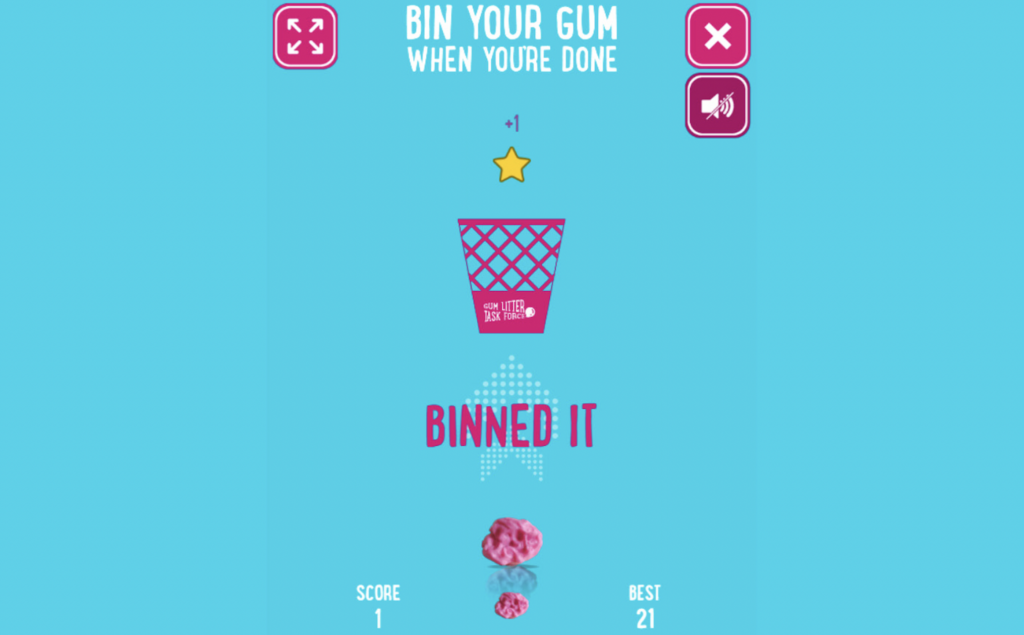
A few years ago, for example, we created an online game for an Irish municipality that wanted to raise awareness against the bad habit of throwing chewing gum on the ground.
The goal of the game was to “score” by throwing gum into a virtual bin, like in a basketball game.
Marketing
In marketing, gamification can take many forms: brands of all sizes launch campaigns driven by game mechanics for different goals, from engagement to data collection and brand growth. Each objective leads to different gamification initiatives.
Examples include offline prize contests, or organizing an amateur sports competition designed to promote a new pair of sneakers.
Education
In educational and outreach contexts, there are more and more tools that rely on gamification dynamics. The goal is to engage children and teenagers more effectively in learning activities by introducing new content and easing the pace of school routines.
Play activities involve both web platforms and offline tools. There are many free platforms where you can create simple games for any subject: math, grammar, geometry, and so on. Teachers and trainers use these apps to propose games and activities to students.
However, for larger and more structured projects, it’s possible to create a custom game for a specific area. Recently, for instance, we designed for a well-known association a virtual path focused on environmental themes, where users find quizzes, questions, mini-videos, and skill games.
In-app
Many web applications implement gamification dynamics to build user loyalty; among them are food delivery apps, which keep growing.
Usually, games are added inside the app to let users earn points and receive prizes or purchase benefits, such as a discount voucher or free delivery.
These types of games can also attract new users through invitation mechanics, for example: “challenge a friend.”
Social media
Social platforms are now essential travel companions for brand visibility and user engagement. Gamification fits perfectly into social content formats thanks to fast interaction and the multiple “languages” of modern communication.
A typical example is Instagram giveaways, contests where users can win prizes in exchange for tags, likes, and shares

Gamification and video games
A few years ago, a service company in the ICT sector commissioned a customized Tetris for the Christmas holidays.
The web game was not aimed at the general public or part of a marketing campaign: it was a “gift” for employees.
In fact, many team-building initiatives are increasingly focusing on online activities, alongside sports and shared experiences.
Making different aspects of corporate life more playful helps tackle goals and tensions, allowing the team to interact differently compared to typical office relationships.
This “principle” can be applied to many contexts, making gamification a highly versatile formula.
In the case mentioned above, the goal was to reward employees during the Christmas party; the chosen tool was an advergame.
In general, advergames can be a strong ally when it comes to gamification. After all, what could make a non-playful activity more attractive than an online game?
Even though gamification has only entered corporate and marketing discussions in recent years, the underlying concept has existed for many decades in promotional contexts.
We at Code This Lab have been developing gaming solutions since 2009, and we have often handled requests involving the creation of “games” meant for non-entertainment sectors and/or events
Among the most requested game types are:
- Sport Game >> for promotional strategies aimed at a broad audience, especially male.
- Casual Game >> for corporate and/or institutional initiatives aimed at a wide and cross-demographic audience.
- Puzzle Game >> for educational/outreach projects aimed at school-age children and teenagers.
- Kids Game >> for educational/training projects aimed at children.
However, the gamification universe is expanding. With the active participation of qualified professionals and the introduction of new tools, the range of action keeps growing, along with the possibilities.
Thank you for your time.
Are you looking for gaming solutions for your gamification initiative, or for your clients?
Sources: Projectfun, Inside Marketing, Gamification, Agenda Digitale, Wikipedia, Treccani, Code This Lab s.r.l.