Video game for sustainability: Sebach brings gaming to Ecomondo
A video game for sustainability: Sebach’s initiative engages, informs, and builds loyalty.
At a trade fair, standing out is not enough.
You need to create an interaction that leaves something behind: a memory, a clear message, a valuable contact.
It is from this need that the project developed by Code This Lab for Sebach was born for Ecomondo 2025, the international event dedicated to the green and circular economy, held at Rimini Expo Centre from November 4 to 7, 2025. In a setting crowded with stimuli, the goal was to create an experience capable of attracting visitors to the stand while, at the same time, turning that attention into a more concrete relationship with the brand.
A project designed to engage and raise awareness
Sebach is a leading company in Italy in the sector of mobile toilets and portable sanitation services, with communication that has long emphasized sustainability, particularly in terms of water saving, impact reduction, and the more responsible use of resources.
On its website, the company presents a structured ESG approach and highlights, among other aspects, solutions designed to limit water consumption and energy use during operation.
For this project, the request was clear. To shape a trade fair activation capable of bringing together three elements that are often treated separately: engagement, education, and lead generation.
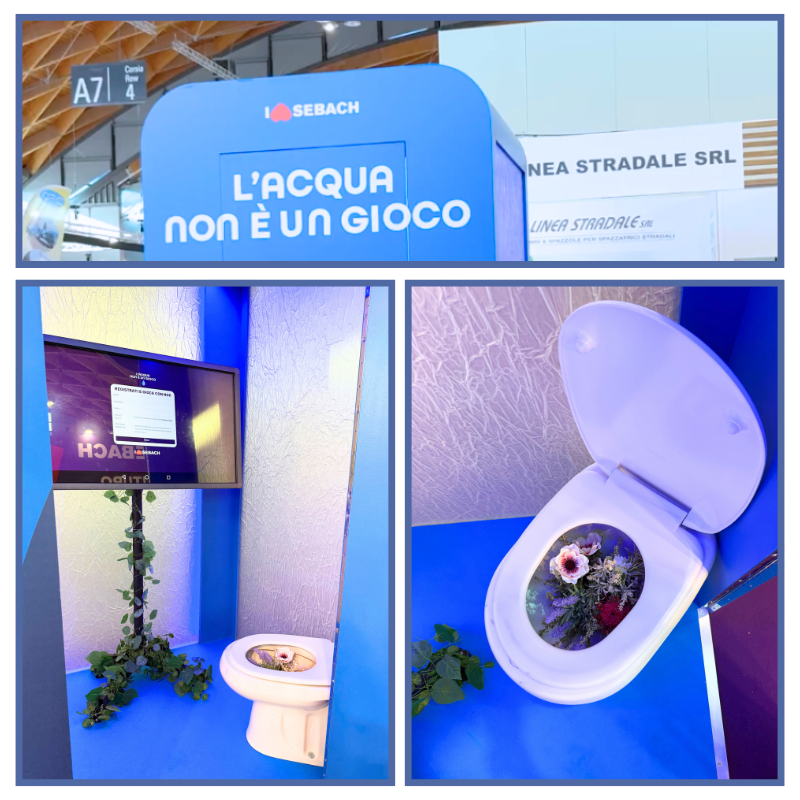
The planned funnel was simple, yet effective:
- Registration
- Gameplay
- Final access to brand content with QRcode
A linear structure, well suited to an exhibition context where everything needs to be immediate: quick access, a game mechanic that can be understood in a matter of seconds, and an ending that guides the user toward more in-depth content.
The video game: a quiz game that makes water consumption visible
For Sebach, we developed a themed quiz game built around two complementary narrative worlds: on one side, the brand; on the other, the theme of water conservation.
The choice of a quiz format was no coincidence. At a trade fair, it works when it is direct, intuitive, and fast, but above all when the game mechanic is not an end in itself: it must reinforce the message.
Here, the core of the project is an immediate metaphor that is fully consistent with Sebach’s world: the toilet flush.
Each correct answer slows down the flow of water and gives the player more time to continue; each wrong answer speeds up the vortex and makes the descent faster, simulating greater consumption. At the end of the session, an algorithm converts the playtime into liters of water consumed, giving the user a result that is concrete, easy to read, and immediate.
This is exactly where gaming stops being just entertainment and becomes a communication tool: an abstract concept such as water waste takes shape in a direct experience, understandable in just a few seconds and memorable because it is lived firsthand.
From the game to the brand message
One of the most interesting aspects of the project is the continuity between the gaming experience and the brand content.
The final QR code leads visitors to Sebach’s sustainability page, creating a natural bridge between the stand activation and the digital in-depth content. In this way, the video game does not end with the match, but becomes the first step in a broader narrative:
- the game captures attention
- the mechanic reinforces the message
- the final content strengthens the brand’s positioning.
This is a particularly effective approach at an event like Ecomondo, which presents itself as a leading international meeting point for ecological transition, the circular economy, and sustainable innovation. In this kind of setting, communicating sustainability does not simply mean stating it: it means making it understandable, tangible, and easy to activate.
Why this case works
The Sebach project clearly shows one of the strengths of advergames applied to events: the ability to turn a brand message into a short but meaningful experience.
In this case, the game works because it:
- starts from a topic that is genuinely central to the brand
- builds a mechanic that is consistent with that topic
- provides the user with immediate feedback
- places the interaction within a funnel that is simple to activate at a trade fair.
There is no distance between content and form. The game mechanic does not merely “dress up” the message: it translates it.
And it is precisely this coherence that makes the experience effective.
Game On Field
With this project, Code This Lab developed for Sebach an activation capable of enhancing the brand’s presence at Ecomondo 2025, increasing audience engagement, and turning a complex topic into an immediate experience.
The result is a case study that clearly shows how gaming can support trade fair communication when it is designed with a precise objective: not only to entertain, but to help people better understand a message, increase attention span, and guide visitors toward a more qualified contact. In this sense, the game is not just a scenic extra: it is part of the strategy.